Activities/Abacus: Difference between revisions
| Line 28: | Line 28: | ||
From left to right: | From left to right: | ||
* project-toolbar button | |||
* saupan button (Chinese abacus) | |||
* soroban button (Japanese abacus) | |||
* schety button (Russian abacus) | |||
* nepohualtzintzin button (Mayan abacus) | |||
* binary button (binary abacus) | |||
* hexadecimal button (hexadecimal abacus) | |||
* fraction button (fraction abacus) | |||
* customization-toolbar button | |||
* stop button not shown | |||
[[Image:Abacus-custom-toolbar.png|left]] | [[Image:Abacus-custom-toolbar.png|left]] | ||
From left to right: | From left to right: | ||
* select the number of rods | |||
* select the number of beads on the top of the frame | |||
* select the number of beads on the bottom of the frame | |||
* select the multiplication factor of top beads (e.g., on the Chinese abacus, each top bead counts as 5× the value of a bottom bead on the same rod) | |||
* select the base to determine the value of bottom beads across rods; this is 10 on most conventional abacuses, but 20 on the Mayan abacus, 16 on the hexadecimal abacus, and 2 on the binary abacus. | |||
== How to use an abacus == | == How to use an abacus == | ||
Revision as of 08:12, 5 June 2010

Where to get Abacus
About Abacus

Abacus lets the learner explore different representations of numbers using different mechanical counting systems developed by the ancient Romans and Chinese. There are several different variants available for exploration: a suanpan, the traditional Chinese abacus with 2 beads on top and 5 beads below; a soroban, the traditional Japanese abacus with 1 bead on top and 4 beads below; the schety, the traditional Russian abacus, with 10 beads per column, with the exception of one column with just 4 beads used for counting in fourths; and the nepohualtzintzin, a Mayan abacus, 3 beads on top and 4 beads below (base 20). There is also a binary abacus, a hexadecimal abacus, and an abacus that lets you calculate with common fractions: 1/2, 1/3, 1/4, 1/5, 1/6, 1/8, 1/9, 1/10, and 1/12. In the soon-to-be released Version 9, there is a customization toolbar that lets you design your own abacus.
-
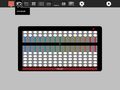 suanpan (Chinese)
 -
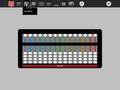 soropan (Japanese)
 -
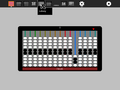 schety (Russian)
 -
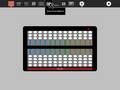 nepohualtzintzin (Mayan)
 -
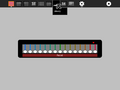 binary (base 2)
 -
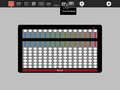 hexadecimal (base 16)
 -
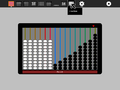 fractions (1/2, 1/3, 1/4,...)
 -
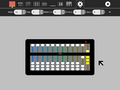 custom, as shown: octal (base 8)


The toolbars

From left to right:
- project-toolbar button
- saupan button (Chinese abacus)
- soroban button (Japanese abacus)
- schety button (Russian abacus)
- nepohualtzintzin button (Mayan abacus)
- binary button (binary abacus)
- hexadecimal button (hexadecimal abacus)
- fraction button (fraction abacus)
- customization-toolbar button
- stop button not shown

From left to right:
- select the number of rods
- select the number of beads on the top of the frame
- select the number of beads on the bottom of the frame
- select the multiplication factor of top beads (e.g., on the Chinese abacus, each top bead counts as 5× the value of a bottom bead on the same rod)
- select the base to determine the value of bottom beads across rods; this is 10 on most conventional abacuses, but 20 on the Mayan abacus, 16 on the hexadecimal abacus, and 2 on the binary abacus.
How to use an abacus
Clear the abacus
Before you start an arithmetic operation, you need to "clear" the abacus. The upper beads should be positioned against the top of the frame and the lower beads should be positioned against the bottom of the frame. This is the default position for the abacus when you launch the activity. (Note that the schety does not have any upper beads. All of the beads in the schety should start in the down position.)
Reading the abacus
In each column, the bottom beads represent 1s and the top beads represent 5s. (The exception is the column in the schety with only 4 beads. These are 1/4 each.) So for each bead you raise up from the bottom in a column add 1 and for each bead you lower from the top in the same column, add 5.
The columns themselves represent decimal positions from right to left, e.g., 1s, 10s, 100s, 1000s, etc. (There are two exceptions: (1) the nepohualtzintzin uses base 20, e.g., 1s, 20s, 400s, 8000s, etc.; and (2) on the schety, the beads to the right of the column with just four beads are 0.1s, 0.01s, 0.001s, and 0.0001s.)
The current value is always displayed on the frame. Experiment and you will quickly learn to write and read numbers.
Examples: In the gallery below, several simple examples are shown. In the gallery of images above, the number 54321 is shown on each of the different abaci.
-
 1 bottom bead is up, corresponding to 1 unit
 -
 1 top bead is down, corresponding to 5 units
 -
 5 bottom beads are up, also corresponding to 5 units
 -
 1 bottom bead is up and 1 top bead is down, corresponding to 6 units
 -
 5 bottom beads are up and 1 top bead is down, corresponding to 10 units (time to "carry" to the left)
 -
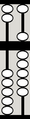 This 10 is equivalent to...
 -
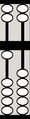 ... this 10
 -
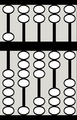 54321
54321


Note: The display always assumes a fixed unit column, but you can override this choice.
-
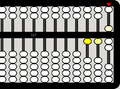 The beads moved most recently are highlighted.

Addition
To add, simply move in more beads to represent the number you are adding. There are two rules to follow: (1) whenever you have a total of 5 units or more on the bottom of a column, cancel out the 5 by sliding the beads back down and add a five to to the top; and (2) whenever you have a total of 10 units or more in a column, cancel out the 10 and add one unit to the column immediately to the left. (With the nepohualtzintzin, you work with 20 rather than 10.)
Example: 4+3+5+19+24=55
-
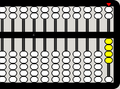 4
4 -
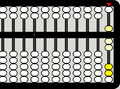 +3=7 (5–2=3)
 -
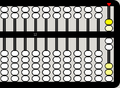 +5=12
+5=12 -
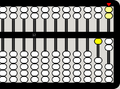 carry 5s to next column
 -
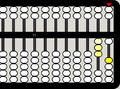 +19=31 (20-1=19)
 -
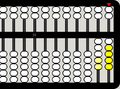 +24=55
 -
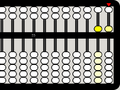 4+3+5+19+24=55


Subtraction
Subtraction is the inverse of addition. Move out beads that correspond to the number you are subtracting. You can "borrow" from the column immediately to the left: subtracting one unit and adding 10 to the current column.
Example: 26–2–4–6–10=4
-
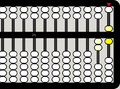 26
26 -
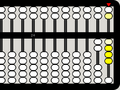 26–2=24
 -
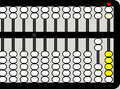 24–4=20
 -
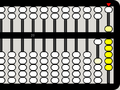 carry 10 to the right
 -
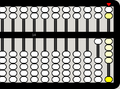 20–6=14
 -
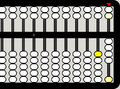 14–10=4


Multiplication
There are several strategies for doing multiplication on an abacus. In the method used in the example below, the multiplier is stored on the far left of the abacus and the multiplicand is offset to the left by the number of digits in the multiplier. The red indicator is used to help keep track of where we are in the process.
-
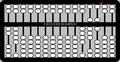 486×24=? Begin by placing 24 in the left-most columns and 486 offset from the far right by two columns (since 24 has two digits). Set the indicator to the right of the multiplicand.
 -
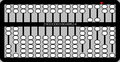 Multiply the least-significant digits (LSD) of the multiplier (4) and multiplicand (6) and place the results (4×6=24) in the far right columns.
 -
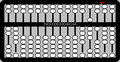 Multiply the next digit in the multiplier (2, which corresponds to 2×10=20) and the LSD of the multiplicand (6) and add the results (2×6=12) on the right (advancing one column to the left to correspond to the power of the digit in the multiplier).
 -
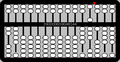 Move the indicator over one column to the left.
 -
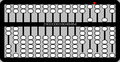 Repeat for the next digit in the multiplicand (8): 4×8=32
 -
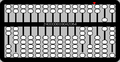 2×8=16
 -
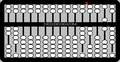 Move the indicator over one column to the left.
 -
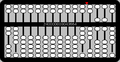 Repeat for the next digit in the multiplicand (4): 4×4=16
 -
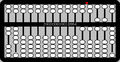 2×4=8
2×4=8 -
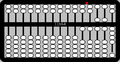 Clear the multiplier from the left and view the result: 486×24=11664


Division
Simple division (by a single-digit number) is the inverse of multiplication. In the example below, the dividend is put on the left (leaving one column vacant for the quotient) and the divisor on the right.
-
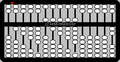 123456789÷2=? Place the dividend (123456789) on the left, leaving one blank column. Place the divisor (2) on the right.
 -
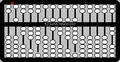 Working from the left to the right, divide a digit in the quotient and then move the indicator one column to the right. 1÷2=0.5
 -
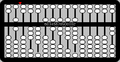 2÷2=1
2÷2=1 -
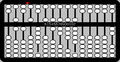 3÷2=1.5
 -
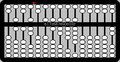 4÷2=2
4÷2=2 -
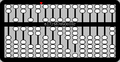 5÷2=2.5
 -
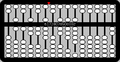 6÷2=3
6÷2=3 -
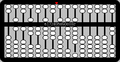 7÷2=3.5
 -
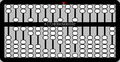 8÷2=4
8÷2=4 -
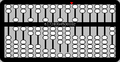 9÷2=4.5
 -
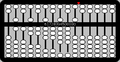 The result is 61728394.5.


TODO: Add instructions for long division.
Discussion
It would be interesting to discuss various lesson plans for using an abacus here. Also, it would be interesting to explore the use of color. What if, for example, the more recent a bead is moved, the more colorful it is? (implemented in v5). This would perhaps make it more clear what the order of operations is on a calculation. Also, what it we extend the idea of the schety to include more fractional components, e.g., 3rd, 5ths, 6ths, etc. and perhaps have a mode where we can automate the consolidation of the fractional parts (implemented in v6).
Might be good to have some of the above information in Help, eg addition, subtraction, multiplication division. Just the text, no graphics?
In git, you can grab v9, which has a customization toolbar. Lots of fun. I'll push the new version once I complete the Sugar 0.84-- version.