Activities/Turtle Art/Galleries: Difference between revisions
< Activities | Turtle Art
No edit summary |
|||
| Line 85: | Line 85: | ||
File:Pie1.png | File:Pie1.png | ||
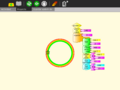
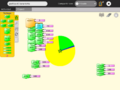
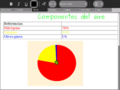
File:Pie2.png|[http://5toescuela3.blogspot.com/2009/07/actividades-para-sugar.html Using Turtle Art for pie charts] | File:Pie2.png|[http://5toescuela3.blogspot.com/2009/07/actividades-para-sugar.html Using Turtle Art for pie charts] | ||
File:Keyboard.png|Q: How do I cast keyboard input to a string? | File:Keyboard.png|Q: How do I cast keyboard input to a string? A: Use chr(). | ||
File:Explicit_approach.png | File:Explicit_approach.png | ||
File:Approximation_approach.png | File:Approximation_approach.png | ||
Revision as of 19:57, 27 February 2011
Learning with Turtle Art
Play with Turtle Art to draw colorful art patterns using a turtle that accepts instructions for movement.
With visual programming blocks, you can snap together programs by compiling (combining) them in ways to create anything you can imagine.


maths
-
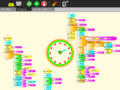
 A clock activity
 -
-
-
-
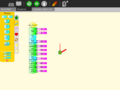
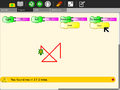
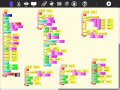 Calculating the hypotenuse and approximating the angle of a right triangle
 -
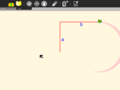 Stepping through the program is a nice way to visualize the process of approximation
 -
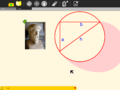 The final result of the approximation.
 -
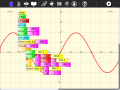 And on-the-fly function definitions


Tony Forster describes his "adventures" with on-the-fly definitions to create an analog clock in his blog.
Try any of the time or math library functions, e.g.,
localtime().tm_min
sin(x) + sin(pi/2)
presentations


games
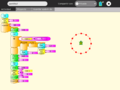
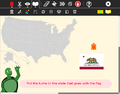
Turtle Art can be used to write games, such as a simple falling block game:


sensors
Turtle Art supports sensor input:
-
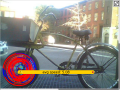 Using a Hall-effect sensor, you can build a bike odometer in Turtle Art

More ideas for sensors [[1]] [[2]]
student work
Students from Caacupé have been sending me examples of their work:
-
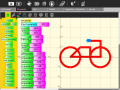 Eduado Fabian Ayala Vargas
 -
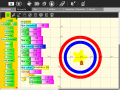 Johana Soeli Aquino
 -
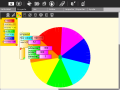 Ivan Silva
 -
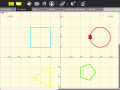 Rodrigo Nicolas Valdéz Bobadilla
 -
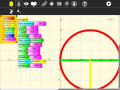 Juan Pablo Espinola Carballo
 -
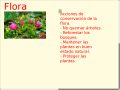 Miguela


Just for fun
-
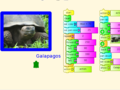 my elder cousin
 -
-
-
-
-
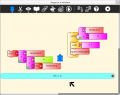 Q: How do I cast keyboard input to a string? A: Use chr().
 -
-
-
-
-


Recent features
-
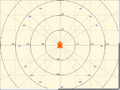 Cartesian and polar coordinate grids
 -
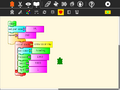 Collapsible stack
 -
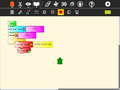 Collapsed stack
 -
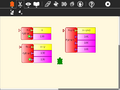 Python function with one, two, or three variables
 -
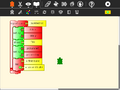 Expandable bullet list (two bullets)
 -
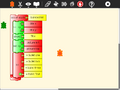 Expandable bullet list (four bullets)
 -
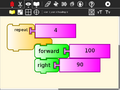 Enlarged blocks
 -
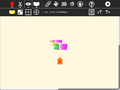 Shrunken blocks
 -
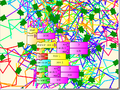 100 Turtles
 -
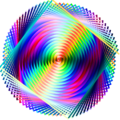 SVG output using the save SVG block
 -
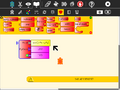 Multi-variable Python blocks
 -
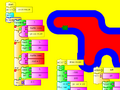 Turtle 'sees'


